
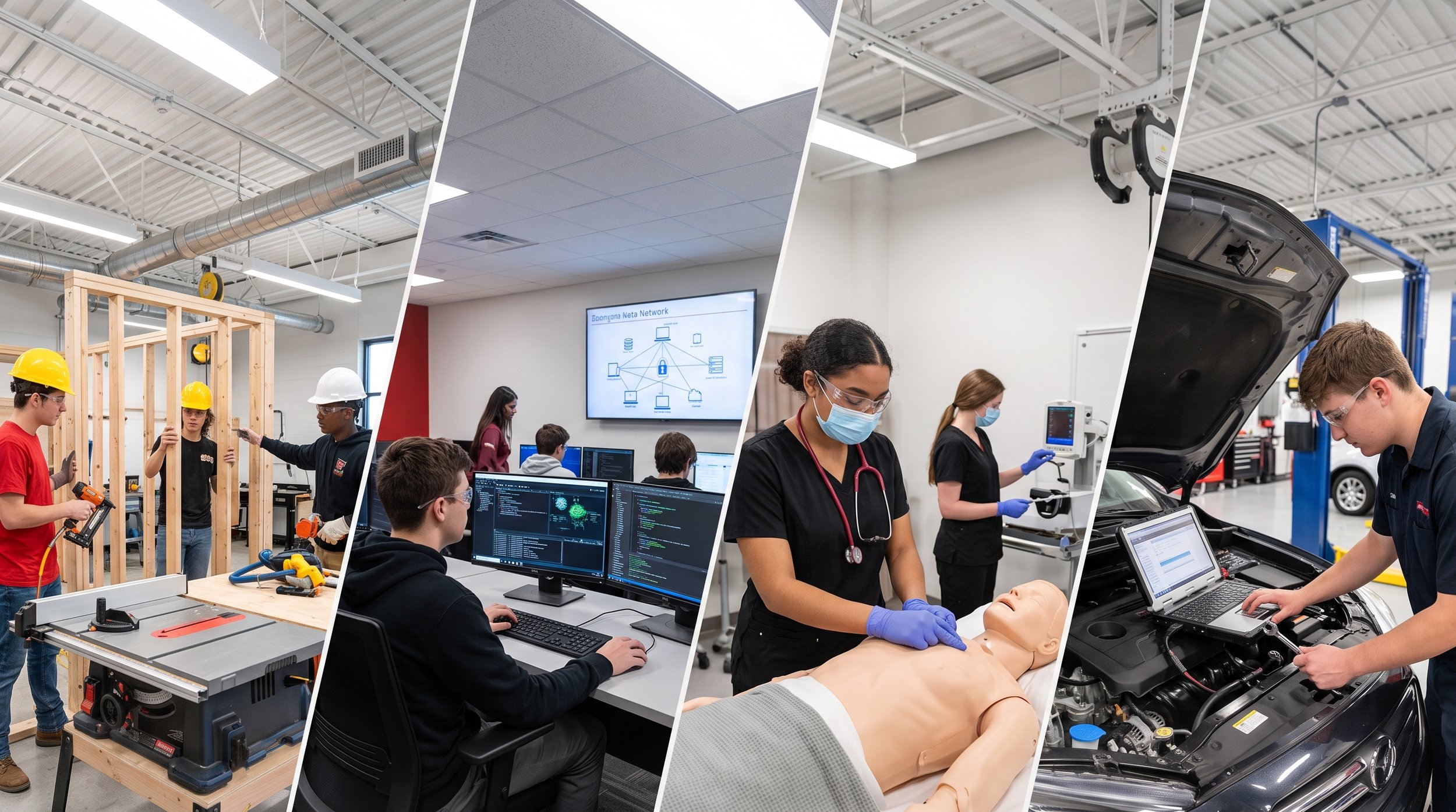
Career and Technical Education Program (CTE)
These educational courses mix traditional academics with practical, real-world job skills.
Certified Nursing Assistant (CNA) Program
Angie Woodyard - London, Mansfield, Marion
Certified nursing assistants play an essential role as members of the healthcare team. Working under the supervision of licensed nurses, CNAs provide compassionate, hands on care to residents and patients in long term care facilities, hospitals, rehabilitation centers, assisted living communities, and home health settings. They help individuals with daily activities while promoting comfort, dignity, independence, and quality of life.
Our Ohio Department of Health (ODH) approved program provides students with the knowledge, skills, and clinical experience necessary to become a competent entry level nursing assistant. Students complete the state required 75 hours of classroom and laboratory training including 16 hours of supervised clinical training in a long term care facility, meeting Ohio’s training requirements for eligibility to take the State Nurse Aid competency examination.
Throughout the course, students will learn:
Basic nursing skills
Safe patient transfers and body mechanics
Measuring and recording vital signs
Resident rights and ethical care
Personal care, including bathing, dressing, and grooming
Infection prevention and control
Communication and teamwork
Upon successful completion of the program, students will be eligible to take the Ohio State Nurse Aide competency examinations and will earn the Ohio Industry Recognized Credential for graduation that is worth 12 points. Students who successfully pass the written and skills exams are placed on the Ohio Nurse Aide Registry and are qualified to begin working as a Certified Nursing Assistant.
Whether your goal is to begin working immediately after receiving your CNA license or continue your education toward becoming an LPN, RN, or other healthcare professional, the CNA credential provides valuable experience and a strong foundation for a future in healthcare.
Construction Trades Program
Marion, Mansfield, Fremont, London, Springfield
Our Construction Trades Program prepares students for careers in the construction industry through hands-on learning and nationally recognized NCCER (National Center for Construction Education and Research) industry credentials. Students develop the skills, knowledge, and work ethic needed to succeed on real job sites.
Throughout the program, students learn to safely use hand and power tools, read and follow construction plans, and complete projects using industry-accepted building methods and standards. Students also gain valuable job site experience through hands-on training that reflects real-world construction practices.
Year 1 – NCCER Core Curriculum
During the first year, students complete the NCCER Core curriculum. This includes basic safety, construction math, proper use of hand and power tools, communication skills, employability skills, and an introduction to the construction industry. Safety is emphasized from day one to prepare students for working on active job sites.
Year 2 – NCCER Carpentry Level 1
In the second year, students move into Carpentry Level 1, where the program becomes even more hands-on. Students learn framing, floor systems, wall construction, roof framing, blueprint reading, material layout, and other essential carpentry skills. Classroom instruction is combined with practical projects that allow students to build confidence while using industry-standard techniques and equipment.
By completing the program, students earn valuable NCCER credentials and graduate with the skills and experience needed to enter the construction workforce, apprenticeships, or continue their education in the skilled trades.
Drivers Education Program
The Driver Education CTE Program prepares students to become safe, responsible, and licensed drivers. Students complete 32 hours of classroom instruction and 8 hours of behind-the-wheel driving instruction taught by qualified instructors following Ohio Department of Public Safety requirements.
The program covers traffic laws, defensive driving, vehicle operation, safe driving practices, and decision-making skills needed for everyday driving. Upon successful completion, students will have met Ohio’s driver education training requirements and will earn an Industry Credential towards Ohio graduation requirements.
Law and Public Safety
The Law and Public Safety program prepares students for careers that focus on protecting and serving their communities. Students explore careers in law enforcement, corrections, emergency medical services (EMS), emergency management, dispatching, and other public safety fields. Through classroom instruction and hands-on learning activities, students develop skills in communication, public speaking, teamwork, leadership, critical thinking, professionalism, and emergency response while learning the importance of safety, ethical decision-making, and working effectively with the public.
Industry-recognized credentials are divided between the first and second year of the program, allowing students to build their knowledge and skills over time.
Additional Industry Credentials and training opportunities are planned for this school year to expand student learning and provide even more career-ready skills.
Current Industry Credentials Include:
NIMS 100 – Introduction to the Incident Command System
NIMS 200 – Basic Incident Command System
NIMS 700 – National Incident Management System
NIMS 800 – National Response Framework
First Aid/CPR Certification
Bloodborne Pathogens Certification
Arts and Communications
The Arts and Communications program gives students hands on experience in graphic design, digital art, and visual communications. Students learn the basics of design, color, layout, typography, image editing, and digital illustration while creating projects for print and digital media.
Students use industry standard software, including Adobe Photoshop and Adobe Illustrator, to edit photos, create logos, design posters, advertisements, flyers, brochures, social media graphics, and other digital artwork. They also learn creative thinking, problem solving, and how to build a portfolio of their work.
The program helps students develop important workplace skills such as communication, teamwork, time management, professionalism, and attention to detail. Students learn how to complete projects, meet deadlines, and present their work with confidence.
This program prepares students for continued education and careers in graphic design, digital media, marketing, advertising, photography, illustration, web design, and other creative fields.
Industry Credentials
Students may have the opportunity to earn Adobe Certified Professional certifications in Adobe Photoshop and Adobe Illustrator.
Boutique Services
Ingrid Young- Springfield, London, Mansfield, Marion
The Boutique Service Program is an intensive, two-year vocational path designed to empower future beauty entrepreneurs. It equips students with the specialized technical talents, sanitization knowledge, and business acumen needed to excel in the rapidly growing boutique beauty industry covering Braiding, Makeup, Shampooing, and Threading.
While this program offers a comprehensive institutional diploma upon completion, it is not required for basic state certification. Instead, it serves as a powerful professional accelerator to build a bulletproof technical toolkit and a sustainable business.
Curriculum Structure
Year 1: Braiding & Business Fundamentals
The inaugural year focuses on mastering natural hair care artistry, health and safety, alongside core foundational skills to build a solid brand and secure financial literacy.
Natural Hair Care Fundamentals: Understanding hair textures, health, and tension management.
Health & Safety: Rigorous training in sanitation, infection control, and hygiene standards.
Braiding Techniques: Mastering sectioning, precise parting skills, and various traditional and modern braiding styles.
Professionalism & Client Communication: Building rapport, conducting thorough consultations, and maintaining industry etiquette.
Marketing & Branding: Defining your unique selling proposition, social media strategy for business, and client retention.
The Business of Beauty: Pricing services accurately, creating profitable service menus, financial literacy, and the fundamentals of entrepreneurship.
Year 2: Salon Services & Professional Practice
The second year expands the student's technical repertoire into highly requested salon offerings while deep-diving into operational workflows and regulatory standards.
Advanced Beauty Tech: Makeup artistry techniques and precision eyebrow threading.
Scalp & Hair Health: Professional shampooing coupled with specialized scalp care services.
Health & Safety: Rigorous training in sanitation, infection control, and hygiene standards.
Salon Operations: Designing efficient salon setup workflows, utilizing appointment scheduling software, and building retail product knowledge to boost ticket averages.
Capstone Project: Creating a comprehensive, investor ready salon business plan.
Automotive Technology
The Automotive Technology CTE Program gives students hands-on experience learning how to inspect, maintain, diagnose, and repair vehicles. Students work on real vehicles using industry-standard tools and equipment while learning automotive safety, basic vehicle systems, customer service, and workplace skills.
Students have the opportunity to earn industry-recognized credentials that prepare them for entry-level automotive careers, apprenticeships, or additional training after graduation.
Year 1 Credentials
CPR Certification
ASE Maintenance & Light Repair
OSHA 10-Hour General Industry
Year 2 Credentials
ASE Engine Repair
ASE Brakes
Students who complete the program will have the skills and certifications needed to begin a career in the automotive industry.
Hydroponics
The Hydroponics and Construction program introduces students to careers in modern agriculture and the skilled trades. Students learn the fundamentals of hydroponic farming, including growing plants without soil, greenhouse operations, plant care, sustainability, and food production. They also develop basic construction skills by learning how to safely use tools, read measurements, complete building projects, and understand construction techniques. Through hands-on learning, students build problem solving, teamwork, communication, and workplace skills while gaining experience in two growing career fields.
Industry recognized credentials are divided between the first and second year of the program, allowing students to build their knowledge and skills over time. We plan to add additional industry certifications and training opportunities during this school year to continue expanding the program and providing students with even more career-ready skills.
Culinary Arts
The Culinary Arts program prepares students for careers in the food service and hospitality industry. Students learn food preparation, cooking techniques, baking fundamentals, kitchen safety and sanitation, nutrition, customer service, and restaurant operations. Through hands-on learning, students gain experience using commercial kitchen equipment while developing skills in teamwork, communication, time management, problem-solving, and professionalism. Students also learn the importance of food safety, quality, and providing excellent customer service in a fast paced work environment.
Industry recognized credentials are divided between the first and second year of the program, allowing students to build their knowledge and skills over time.
Forklift Operations
The Forklift Operations program prepares students with the knowledge and hands on skills needed to safely operate powered industrial trucks in a variety of industrial and commercial settings. Through classroom instruction and practical training, students learn OSHA safety standards, equipment identification, pre-operation inspections, load capacity, stability principles, safe material handling, stacking and unstacking procedures, workplace hazard recognition, and accident prevention.
Students gain experience operating forklifts in simulated and supervised work environments while developing the technical and employability skills expected by today’s workforce. Instruction also emphasizes inventory control, warehouse operations, logistics, communication, teamwork, professionalism, problem-solving, and workplace ethics. Students learn the importance of maintaining equipment, completing safety inspections, understanding warehouse traffic patterns, and following employer safety policies and procedures.
This program helps prepare students for careers in warehousing, manufacturing, distribution, transportation, construction, retail, and supply chain operations. It also provides a strong foundation for students pursuing additional education or industry training in logistics and industrial operations.
Industry Credentials
Students who successfully complete the required classroom instruction, hands on training, and skills evaluation may earn an OSHA compliant Powered Industrial Truck (Forklift) Operator certification, demonstrating they have met industry recognized standards for safe forklift operation.